By Umar Daraz | June 12, 2026 | 3 Min Read
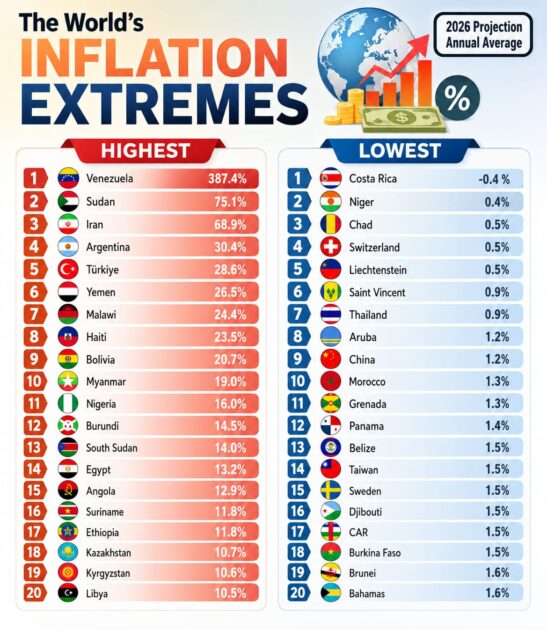
Inflation has eased across many major economies, but several countries continue to experience significant price instability in 2026. According to the International Monetary Fund’s (IMF) World Economic Outlook (April 2026), the gap between the world’s highest and lowest inflation rates remains striking.
At one end of the spectrum, Venezuela is projected to record an annual inflation rate of 387.4%, the highest in the world. Meanwhile, Costa Rica is expected to be the only country experiencing deflation, with consumer prices projected to decline by 0.4%.
Venezuela’s Ongoing Inflation Crisis
Venezuela continues to suffer from one of the world’s most severe economic crises. Years of political instability, economic mismanagement, currency depreciation, and declining productivity have contributed to runaway inflation.
The country’s economy has long depended on oil exports. When global oil prices collapsed in 2014, Venezuela’s economic vulnerabilities were exposed, triggering a prolonged downturn. Despite possessing the world’s largest proven oil reserves, the nation has struggled to rebuild economic stability. IMF data projects Venezuela’s average inflation rate at 387.4% in 2026.
Several other resource-rich but economically challenged nations are also expected to post elevated inflation rates, including Iran, Nigeria, and Libya.
Caribbean Nations Maintain Low Inflation
In contrast, several Caribbean and Central American economies are expected to enjoy relatively stable prices in 2026.
Countries such as Aruba, Belize, Grenada, Panama, Saint Vincent and the Grenadines, and the Bahamas are projected to maintain inflation rates in the low single digits. Their economic stability stands in sharp contrast to the inflationary pressures seen elsewhere.
Costa Rica is particularly noteworthy as the only country projected to experience deflation. While lower prices may appear beneficial for consumers, prolonged deflation can discourage spending, reduce business revenues, and slow economic growth.
How Countries Are Fighting Inflation
Central banks around the world continue to use monetary policy tools to combat inflation. Interest rate increases remain one of the most common strategies for controlling rising prices and stabilizing inflation expectations.
Governments are also implementing fiscal reforms to improve economic stability. Argentina provides a notable example. Under President Javier Milei, the government has reduced public spending and cut subsidies in an effort to lower inflation. As a result, Argentina’s inflation rate is projected to decline significantly, although it remains elevated at 30.4% in 2026.
Milei has also advocated for dollarization—replacing Argentina’s peso with the U.S. dollar—to prevent future inflationary cycles. However, Argentina continues to use its national currency as of 2026.
Global Inflation Outlook
The IMF expects global inflation pressures to remain manageable overall, although geopolitical tensions and energy market disruptions continue to pose risks. The organization’s April 2026 outlook projects global economic growth of 3.1% in 2026 while warning that prolonged conflicts and supply disruptions could reignite inflation in several regions.
While many countries have made progress in bringing inflation under control, the stark contrast between Venezuela’s hyperinflation and Costa Rica’s deflation highlights the diverse economic challenges facing nations around the world in 2026.
Key Takeaways
Venezuela is projected to have the world’s highest inflation rate at 387.4%.
Costa Rica is expected to be the only country experiencing deflation, with prices falling by 0.4%.
Several Caribbean nations are maintaining inflation rates near historic lows.
Governments and central banks continue to rely on fiscal reforms and monetary policy to control inflation.
Global inflation remains vulnerable to geopolitical conflicts and energy price shocks.

Umar Daraz is the Founder and Editor of TodayEast, an independent digital news platform covering global affairs, business, technology, sports, and world rankings. He specializes in data-driven journalism, international news analysis, economic trends, and emerging technologies. Through TodayEast, he aims to provide accurate, accessible, and insightful reporting on the stories shaping the world.