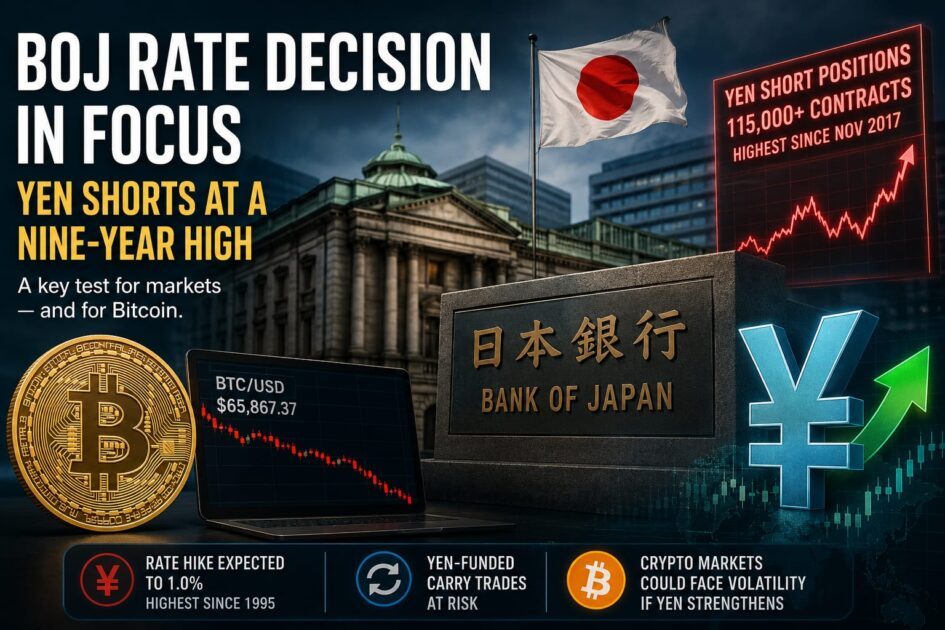
While cryptocurrency investors often pay close attention to U.S. Federal Reserve announcements, this week another central bank is attracting significant attention. The upcoming BOJ Rate Decision by the Bank of Japan could have important implications for Bitcoin and broader financial markets.
The Bank of Japan is widely expected to increase its benchmark interest rate from 0.75% to 1.0%. If implemented, the move would push Japanese interest rates to their highest level since 1995. Although such a decision may appear unrelated to cryptocurrency markets at first glance, analysts believe it could trigger significant reactions across global assets, including Bitcoin.
Why the BOJ Rate Decision Matters
The key issue is the unusually large number of investors betting against the Japanese yen. Recent data from the Commodity Futures Trading Commission shows that leveraged funds have built more than 115,000 short contracts against the yen, the highest level seen since 2017.
These traders expect the yen to weaken further. However, if the Bank of Japan raises rates and signals additional tightening measures ahead, many of those investors may be forced to close their positions.
This process, known as a short squeeze, can lead to a rapid appreciation of the yen. Such a move could have ripple effects across multiple financial markets.
Impact on Yen-Funded Carry Trades
For years, investors have taken advantage of Japan’s historically low interest rates through a strategy known as the carry trade. Under this approach, investors borrow money in yen at low costs and invest in higher-yielding assets elsewhere.
These investments often include stocks, bonds, and even riskier assets such as cryptocurrencies. The availability of cheap funding has helped support global market liquidity and encouraged investors to seek higher returns.
However, a stronger yen can make these trades less attractive. If investors begin unwinding carry trades, capital may flow out of risk assets, creating downward pressure on markets worldwide.
Lessons from the 2024 Market Shock
Many traders are comparing the current situation with events that unfolded in July 2024.
At that time, speculative short positions against the yen had also reached extreme levels before the Bank of Japan announced a rate increase. Following the decision, the yen strengthened sharply as traders rushed to close their positions.
The resulting volatility affected major stock markets, including Japan’s Nikkei index and U.S. equities. Cryptocurrency markets also experienced significant turbulence.
Bitcoin, which was trading near $65,000 before the announcement, fell to approximately $50,000 within a week. The decline highlighted how sensitive digital assets can be to changes in global liquidity conditions.
What Traders Should Watch
Market participants are not only focused on whether the Bank of Japan raises rates but also on the language used by Governor Kazuo Ueda during and after the meeting.
If the central bank delivers the expected rate increase while maintaining a cautious outlook, financial markets may react calmly. Investors have largely priced in a move to 1.0%, reducing the risk of a major surprise.
On the other hand, stronger-than-expected guidance could have a much larger impact. If Ueda signals that additional rate hikes are likely or suggests that interest rates may move significantly above 1%, investors could reassess their positions rapidly.
Such a scenario would likely strengthen the yen, increase volatility, and potentially pressure risk assets including Bitcoin.
Potential Impact on Bitcoin
Bitcoin has historically responded strongly to changes in liquidity and investor risk appetite. When borrowing costs rise and liquidity tightens, speculative assets often face selling pressure.
A significant appreciation in the yen could force investors to reduce exposure to riskier investments. This process could create short-term headwinds for Bitcoin and the broader cryptocurrency market.
However, the long-term outlook may depend on broader economic conditions and investor sentiment beyond Japan’s monetary policy. While short-term volatility is possible, many analysts believe Bitcoin’s long-term trajectory will continue to be influenced by institutional adoption, regulatory developments, and macroeconomic trends.
Conclusion
The upcoming BOJ Rate Decision has become one of the most important events on the global financial calendar this week. With speculative yen short positions at a nine-year high, any indication of more aggressive monetary tightening could trigger significant market reactions.
Bitcoin traders, in particular, should monitor both the interest rate announcement and Governor Kazuo Ueda’s comments. A cautious message may help markets remain stable, but a hawkish surprise could strengthen the yen, unwind carry trades, and create fresh volatility across cryptocurrencies and other risk assets.
As history has shown, decisions made in Tokyo can sometimes have a much larger impact on Bitcoin than many traders initially expect

Umar Daraz is the Founder and Editor of TodayEast, an independent digital news platform covering global affairs, business, technology, sports, and world rankings. He specializes in data-driven journalism, international news analysis, economic trends, and emerging technologies. Through TodayEast, he aims to provide accurate, accessible, and insightful reporting on the stories shaping the world.