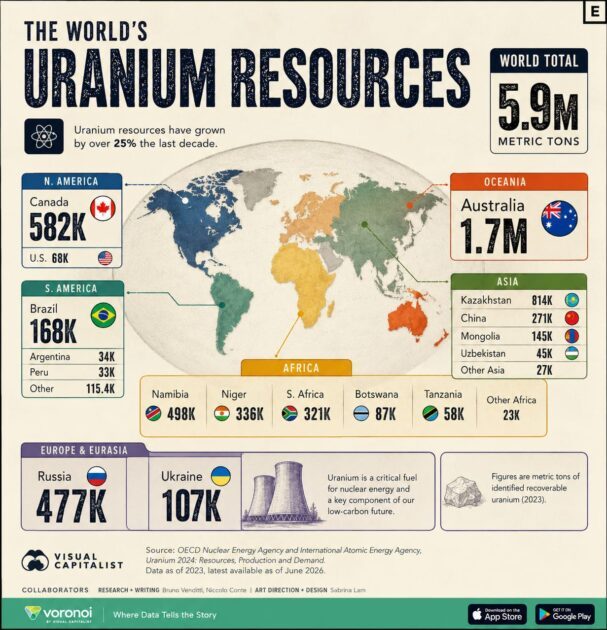
Global demand for nuclear energy is increasing, making Uranium Resources by Country 2026 a key topic for governments, investors, and energy planners worldwide.
According to the latest data from the OECD Nuclear Energy Agency and the International Atomic Energy Agency, identified global uranium resources reached nearly 5.9 million tonnes in 2023. These resources represent uranium that can be economically recovered at current market conditions.
Australia Holds the Largest Uranium Resources
Australia remains the world’s leading uranium resource holder with approximately 1.67 million tonnes of identified recoverable uranium. This accounts for around 28% of global uranium resources.
Despite its massive reserves, Australia does not produce as much uranium as some other major mining countries. Regulatory policies and lengthy project development timelines have limited production growth.
Top Countries with the Largest Uranium Resources
1. Australia – 1.67 million tonnes (28%)
2. Kazakhstan – 813,900 tonnes (14%)
3. Canada – 582,000 tonnes (10%)
4. Namibia – 497,900 tonnes (8%)
5. Russia – 476,600 tonnes (8%)
6. Niger – 336,000 tonnes (6%)
7. South Africa – 320,900 tonnes (5%)
8. China – 270,500 tonnes (5%)
9. Brazil – 167,800 tonnes (3%)
10. Mongolia – 144,600 tonnes (2%)
Together, Australia, Kazakhstan, and Canada control more than half of the world’s identified uranium resources.
Kazakhstan and Canada Play a Critical Role
While Australia has the largest reserves, Kazakhstan and Canada are among the world’s top uranium producers. Their mining industries are well-developed and play a crucial role in supplying fuel to nuclear power plants worldwide.
Kazakhstan alone possesses 14% of global uranium resources, while Canada contributes 10%.
Why Uranium Resources Matter
As countries seek cleaner energy sources and lower carbon emissions, nuclear power is gaining renewed attention. Uranium is the primary fuel used in nuclear reactors, making reliable supplies increasingly important for long-term energy security.
Growing investment in nuclear energy projects has also encouraged exploration activities, helping increase identified uranium resources by more than 25% over the last decade.
Future Outlook
The future of the global nuclear industry will depend heavily on nations with large uranium reserves. Australia, Kazakhstan, Canada, and several African countries are expected to remain strategic suppliers as demand for low-carbon electricity continues to rise.
With energy security becoming a top priority for many governments, uranium resources are likely to play an even bigger role in the world’s energy transition.

Umar Daraz is the Founder and Editor of TodayEast, an independent digital news platform covering global affairs, business, technology, sports, and world rankings. He specializes in data-driven journalism, international news analysis, economic trends, and emerging technologies. Through TodayEast, he aims to provide accurate, accessible, and insightful reporting on the stories shaping the world.